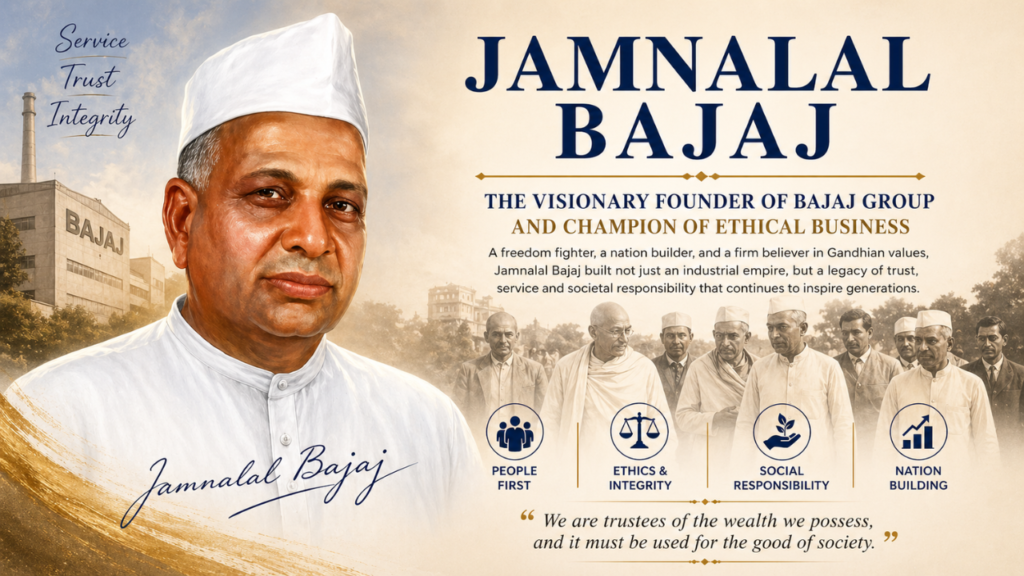
Jamnalal Bajaj was one of the most respected industrialists, freedom fighters and philanthropists in India. Bajaj is known as the founder of the business empire that is still alive in 2026. But his life story far exceeds corporate success. He was the man who thought business means should contribute to society, should back the nation and should centre value.
Jamnalal Bajaj built enterprises based on honesty and self-reliance at a time when India was under colonial domination, and Indian entrepreneurs were severely curtailed. He also emerged as a close aide of Mahatma Gandhi and was an important figure in India’s freedom struggle. He embodies a very rare arc of where leadership, patriotism and entrepreneurship intersect.
Jamnalal Bajaj is remembered even today as a torchbearer of ethics in business. Through the Bajaj Group, respected Institutions, and social initiatives that continue to this day in embodying what he valued.
Early Life and Background
Jamnalal Bajaj came into this world on 4 November 1889 in Kashi Ka Bas, near Sikar of Rajasthan. Coming from a middle-class family, his childhood days were simple.
He was adopted as a child by Seth Bachhraj Bajaj, an affluent trader based in Wardha. It changed the trajectory of his future from then on. By this adoption, he was brought into a family of businessmen and since then got enlightened on the trade, commerce, and monetary discipline.
Even in childhood, Jamnalal had a certain maturity of mind, was alert and bright and seemed to have an intuitive understanding of people. He understood the nature of markets, how merchants accrued trust with each other and why reputation counts in business.
And much more than worldly skills, he got sympathy. He understood the poverty and inequality which surrounded him. Those experiences became the values that would later inform his business career and social work.
Quick Facts About Jamnalal Bajaj
| Category | Details |
| Full Name | Jamnalal Kaniram Bajaj |
| Born | 4 November 1889 |
| Birthplace | Kashi Ka Bas, Rajasthan |
| Died | 11 February 1942 |
| Known For | Founder of Bajaj Group |
| Profession | Industrialist, Freedom Fighter |
| Associate of | Mahatma Gandhi |
| Legacy | Ethical business & philanthropy |
Also Read: Ritesh Agarwal | Alakh Pandey
Beginning of the Bajaj Group
Bajaj Group was founded in 1926 by Jamnalal Bajaj. This was a brave move as there were hardly any places that Indian-owned business on British Raj. In almost all sectors, foreign companies were ruling, and Indian entrepreneurs were never treated fairly.
These challenges notwithstanding, Jamnalal believed that India needed big domestic players. He knew that economic independence was tied to political freedom. If progress was truly to be made for Indians, India needed its industry, jobs and brands.
The group started on the trading and manufacturing side. It gradually diversified itself into multiple verticals and carved out a niche reputation of reliability. Jamnalal always believed in growing slowly and surely, rather than taking unnecessary risks.
His philosophy was simple: build trust first, profits later. This approach became one of the major salutes to the Bajaj name.
What Set Him Apart Are His Business Values
Most of the businessmen around him only care about making money. Jamnalal Bajaj was different. He felt owners of businesses owed something to workers, customers and society.
He stressed transparency in dealings, fair pricing and responsible handling. He thought a company should gain respect before it makes money.
Core Values He Followed
- Integrity in every transaction
- Long-term vision over short-term gains
- Respect for employees and customers
- National development through enterprise
- Social responsibility with success
Those values were out of their time. Even most companies now talk about ethics and sustainability, but Jamnalal Bajaj was practising it many years ago, almost 100 years back.
Connection with Mahatma Gandhi
Jamnalal Bajaj was a close associate of Mahatma Gandhi. He enjoyed Gandhi’s utmost confidence and was, by now, famously called “my fifth son” by him.
The title reflected love but reciprocal respect as well. Jamnalal backed Gandhi, both financially and personally. He was involved in organising campaigns and meetings however, to support nationalists, and also contributing.
He was an active supporter, not a passive one. He fought for the freedom of India and sacrificed a lot in that struggle.
Jamnalal Bajaj was firmly convinced that rich Indians should give their submit themselves up to somebody else’s slavery instead of living peacefully under colonialism. It earned him a place amongst the most revered industrialists of the independence era.
Role in the Freedom Movement
Jamnalal Bajaj was involved in many prominent national movements. Political independence, he felt, was vital to secure the future of India.
He campaigned for Gandhi and advocated swadeshi openly. His role in this resulted in him being imprisoned by the British, too.
Movements He Supported
- Non-Cooperation Movement
- Civil Disobedience Movement
- Promotion of Khadi
- Swadeshi campaigns
- Rural upliftment programs
His own bravery proved civics wasn’t just for politicians and activists. Business leaders also helped shape the nation.
Social Reforms and Public Welfare
The answer is Jamnalal Bajaj, who devoted his life to social upliftment. And he wanted not just freedom for India, but justice and inclusiveness.
He fought for the abolition of untouchability and the caste system. Even more audacious for that period of time, he threw open the doors of the Laxmi Narayan Temple to Harijans in Wardha in 1928. Temples had continued to deny entry to lower caste communities till then.
He also advocated for rural development, women’s empowerment, education and health care. He reasoned that villages were the backbone of India and needed equal development.
Areas of Social Contribution
- Temple entry reforms
- Rural welfare projects
- Education support
- Healthcare assistance
- Equity and respect for marginalised communities
The admiration for his charitable work extended well beyond business circles.
Expansion of the Bajaj Legacy
Following the death of Jamnalal Bajaj on 11 February 1942, his family continued to carry forward his vision. After independence, his two sons, Kamalnayan Bajaj and Ramkrishna Bajaj, enlarged the group.
Rahul Bajaj would go on to become one of the most recognisable names among industrial leaders in India. And Bajaj Auto emerged as a household name under his leadership. The iconic Bajaj scooter and the tagline “Hamara Bajaj” became emblems of middle-class aspirationalism in India.
The group also diversified into finance, insurance and consumer businesses in subsequent decades. Bajaj Finance, Bajaj Finserv and a few others outperformed the industry.
It is rare to see such multi-generational success, and a testament to the strong footing laid by Jamnalal Bajaj.
Bajaj Group in 2026
The Bajaj Group is still one of the most formidable business houses in India in 2026. The public remains interested in a mix of sectors and continues to grow.
Major Companies in 2026
- Bajaj Auto
- Bajaj Finance
- Bajaj Finserv
- Bajaj Electricals
- Mukand Ltd
- Bajel Projects
The group had also revealed a big entry into healthcare with investments running into thousands of crores. This effectively indicates the Bajaj Group’s persistent ability to evolve with India even after the end of seven decades.
The core principle behind its growth today continues to be the same value creation that Jamnalal Bajaj stood for, which was a vision for the long term as opposed to short-term reaction policies.
Why Jamnalal Bajaj Is Still Relevant Today
In 2026, Jamnalal Bajaj continues to be relevant. Profits do not just set the pace of survival for modern businesses, but also ethical, sustainable and social responsibility. Jamnalal had the same values long before the rest of the world jumped on those bandwagons.
He showed that you can be both successful and serve. He practised having wealth in a way that elevated society rather than having society become distant from it.
His journey has a lot of takeaway points for young entrepreneurs.
Lessons for Modern Entrepreneurs
- Build trust before chasing growth
- Stay ethical in difficult times
- Use success to help society
- Play long term, not short term
- Lead with humility and purpose
These lessons are timeless.
Jamnalal Bajaj Foundation and Institutions
Jawaharlal Nehru supported Jamnalal Bajaj’s values; thus, the Jamnalal Bajaj Foundation was the end result. It is a recognition of the people and organisations involved in rural development, science, social service, and Gandhian thought.
Prestigious Jamnalal Bajaj Awards have been bestowed upon eminent persons from India & abroad.
His name survives, as also in institutions such as the Jamnalal Bajaj Institute of Management Studies (JBIMS) in Mumbai, one of the best management colleges in India.
And these institutions guarantee that future generations will be learning from his ideals.
Also Read: Akanksha Chamola | What Does PMO Mean in Text
Conclusion
But nonetheless, Jamnalal Bajaj was not only the founder of a business house. He was the creator of a value-based legacy. He proved that you don’t have to sacrifice ethics to profit, and leaders could create wealth while serving humanity.
From a small village in Rajasthan to one of India’s most trusted conglomerates, his journey is nothing short of sensational. No matter how you cut it, his inputs to very particular parts of industry, freedom, and reform alone qualify him as one of the most consequential people in Indian business history.
As the Bajaj Group ventures into other verticals and global territories, Jamnalal Bajaj remains not only a figure but also an ethos in 2026 onwards, with trust, responsibility, and nation-building on the radar.
Frequently Asked Questions (FAQs)
1. Who was Jamnalal Bajaj?
Jamnalal Bajaj, industrialist and philanthropist, freedom fighter, founder of the Bajaj Group
2. Why is Jamnalal Bajaj famous?
He is well known for constructing the Bajaj business empire and supporting Mahatma Gandhi throughout freedom struggle in India.
3. Which Companies Come Under Bajaj Group 2026
Companies in the group are Bajaj Auto, Bajaj Finance, Bajaj Finserv, Bajaj Electricals and Mukand, another venture in health care.
4. What values did they have, Jamnalal Bajaj?
He had a conviction of being accountable, of social responsibility, and that people should have autonomy, and how businesses do good ethics.
5. What relevance does Jamnalal Bajaj hold today?
His profit with purpose model continues to be highly relevant for today’s entrepreneurs.