Technology is advancing rapidly, and two terms that persistently change the digital space are artificial intelligence (AI) and machine learning. Now these technologies are so worked into our everyday life, from simple virtual assistants and recommendation systems to self-driving cars and sophisticated healthcare tools.
Most folks use these terms interchangeably, but there is a distinct difference. Given that these technologies are changing industries all around the world, understanding artificial intelligence and machine learning is essential for students, businesses, developers, and ordinary users. Machine learning, according to other technology resources, is age-based and falls under the subset of artificial intelligence that enables systems to learn from data and improve over time.
This exhaustive guide is a go-to source that tells all of the essential information regarding artificial intelligence and machine learning, covering definition, the difference between AI and ML, application areas, advantages, challenges & future opportunities.
What is Artificial Intelligence?
This article goes in-depth into Artificial Intelligence (AI), the ability of a machine to perform tasks based on human intelligence. These tasks encompass reasoning, decision-making, speech recognition, problem-solving, and language understanding.
AI aims to develop systems that can carry out inferences and actions without human intelligence. They can process data, identify patterns, and decide upon the available information.
AI is basically divided into Narrow AI, General AI, and Super AI. This is due to the fact that most of the technology we have available today is Narrow AIs; these systems are trained only for specific tasks.
What is Machine Learning?
Machine Learning, commonly known as ML, is a subset of AI and provides you with the capability of training a system to learn without having written code for every single.
Machine learning models do not work on predefined rules; they identify correlations from the data and get better. This is why machine learning works so well for predictions, recommendations, and automation.
Examples of machine learning include:
- Email spam filters
- Netflix recommendations
- Voice assistants
- Fraud detection systems
- Predictive analytics
Machine learning is one of the most important technologies behind modern AI systems.
Artificial Intelligence and Machine Learning Overview
| Feature | Artificial Intelligence | Machine Learning |
| Definition | Simulation of human intelligence in machines | A subset of AI focused on learning from data |
| Main Goal | Create intelligent systems | Improve accuracy through learning |
| Approach | Logic, reasoning, decision-making | Statistical models and algorithms |
| Dependency | Can work with or without data | Highly dependent on data |
| Applications | Robotics, assistants, automation | Prediction, recommendations |
| Complexity | Broader field | Specific branch of AI |
Also Read: Genmo AI | Hotpot AI Guide
Artificial Intelligence and Machine Learning Throughout History
Similarly, the idea of artificial intelligence and machine learning has existed for numerous decades. The 1950s marked the dawn of AI research when scientists asked if machines could simulate human thought.
Later on, as computing power and the availability of data increased, machine learning started getting some excitement. The developments in algorithms, cloud computing, and neural networks have also improved the speed at which both technologies have grown over the years.
At present, Artificial Intelligence and machine learning are the fastest-growing domains in technology.
How Artificial Intelligence Works
Artificial intelligence really works by combining x algorithms, y data processing, and z computational power. It means that as AI systems unfurl, they gather information and interpret patterns developing in the world based on preset objectives.
Modern AI includes so many technologies, like:
- Natural Language Processing (NLP)
- Computer Vision
- Robotics
- Speech Recognition
- Expert Systems
These technologies enable AI systems to communicate with humans and execute complex projects swiftly.
How Machine Learning Works
Machine learning processes use algorithms that are trained on datasets. It examines data patterns and learns how to make predictions or decisions.
Machine learning models are continually developed based on increased information. Performance is much more related to the amount/quality of data.
The machine learning is of a different kind-
- Supervised Learning
- Unsupervised Learning
- Reinforcement Learning
Each type has its own use cases based on the problem you are trying to solve.
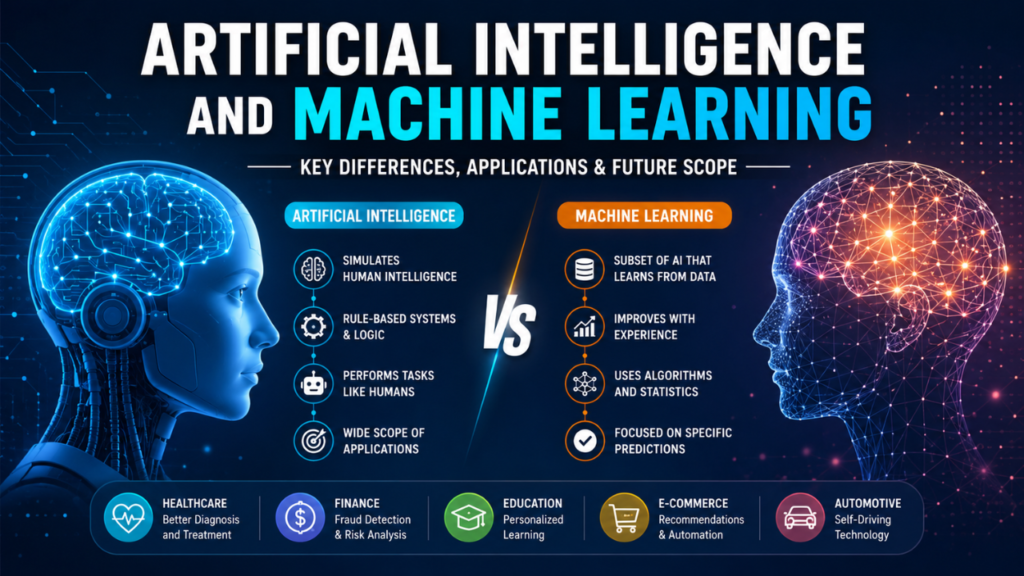
Main Distinctions of Artificial Intelligence and Machine Learning
It’s easy to confuse AI and ML; however, there are some key differences between the two.
This is why you may often see the terms artificial intelligence and machine learning thrown around, because AI is the more overarching idea of creating intelligent systems, and ML is a smaller cow herding that eats data automatically. Machine learning is primarily focused on statistical learning techniques, whereas AI can include rule-based systems included in it.
One of the most significant differences is that while AI makes an effort to reason and decide, ML becomes more about pattern recognition and accuracy improvement.
Applications of Artificial Intelligence
This is because the reach of artificial intelligence and machine learning is increasing with every passing day, penetrating almost all sectors.
AI is widely used in:
- Virtual Assistants like Siri and Alexa
- Self-driving vehicles
- Smart robotics
- Healthcare diagnostics
- Financial fraud detection
- Customer service chatbots
This use case presents how AI improves automation and efficiency in our daily lives.
Applications of Machine Learning
Machine learning is vital for data analytics and predictive systems.
Common ML applications include:
- Recommendation systems
- Stock market predictions
- Spam email detection
- Personalized advertisements
- Image recognition
- Predictive maintenance
Use machine learning in situations where systems must constantly improve on new data.
Advantages & Challenges
| Advantages | Challenges |
| Automation of repetitive tasks | Data privacy concerns |
| Improved accuracy | High computational requirements |
| Faster decision-making | Bias in datasets |
| Personalized user experience | Expensive implementation |
| Better business insights | Complex model training |
Role of Deep Learning
Deep learning is an area connected to artificial intelligence (AI) and machine learning (ML). It is a branch of machine learning that works with neural networks.
Deep Learning models are good at handling data of various types and can practically ingest large volumes of information; they have already proven to be useful in the fields of image recognition, speech processing, and even language generation.
Newer AI systems, generative AI tools, for instance, depend on deep learning technologies to a great extent.
Artificial Intelligence in Healthcare
AI and ML is one of the most beneficial sectors in healthcare.
AI systems assist doctors in analyzing medical images, predicting diseases, and suggesting treatments. Machine learning models can explore real-world data about patients in order to recognize health threats earlier.
It will enable precise diagnosis and lessen the load of healthcare professionals.
Artificial Intelligence in Finance
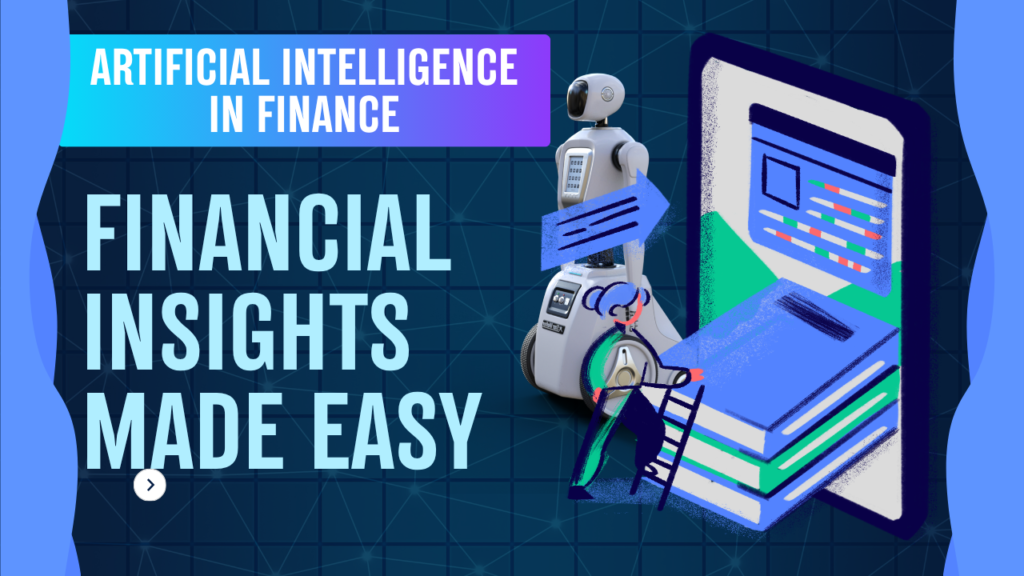
The financial industry harnesses AI and Machine learning for fraud prevention, algorithmic trading,, customer service automation.
Transaction patterns are constantly analyzed in milliseconds by machine learning algorithms to determine whether the transaction appears to be legit or seems fraudulent. Role of AI in Improving the Customer Support Experiences
Artificial Intelligence in Education
AI-driven learning systems are now being embraced by educational platforms. Education: Think personalized learning recommendations, automated grading, and virtual tutors.
When educational software uses machine learning, it adjusts based on how well a student is doing and their learning behaviors.
Pros and Benefits of AI and ML
Some of the important reasons why companies are investing so much in AI and ML are listed below.
- Increased automation
- Improved productivity
- Better decision-making
- Reduced human error
- Faster data analysis
- Enhanced customer experience
These benefits are the reasons why AI-powered systems are becoming increasingly popular all over the globe.
Challenges & Limitations
However, despite having such advantages, artificial intelligence and machine learning also come with challenges. Another big issue that you are going to have is data privacy and security. AI systems are data hungry, and thus, there is concern for how data can be abused, but also protected.
Another issue is algorithm bias. If the training data is biased, so may be the resulting AI systems. Furthermore, AI system implementation can be costly and technically demanding.
Job opportunities for AI and ML
As the market for artificial intelligence and machine learning tightly has gone up. As per several industry reports, organizations across sectors regularly run along the line for hiring AI engineers, data scientists, and machine learning specialists.
Popular career roles include:
- AI Engineer
- Machine Learning Engineer
- Data Scientist
- NLP Specialist
- Robotics Engineer
They provide professional opportunities for high-paying and fast-growing careers.
Next-generation AI and ML
The prospect of artificial intelligence and machine learning seems extraordinarily bright. Experts say it will continue to can transform industries like healthcare, transportation, education, and entertainment.
Future developments may include:
- Smarter virtual assistants
- Advanced robotics
- More accurate predictive systems
- AI-powered automation
- Improved natural language understanding
The technology is advancing rapidly and is expected to improve the performance of AI systems in the front line.
Deep Learning vs Machine Learning vs Artificial Intelligence
And, a lot of people also compare AI vs ML vs DL with each other.
- AI is the broadest concept
- ML is a subset of AI
- Deep learning is a subset of ML.
Deep learning is specifically for neural networks, whereas machine learning spans different kinds of learning techniques.
Also Read: Pixverse AI | Haiper AI
Conclusion
In this technology-driven world, knowledge of artificial intelligence and machine learning has become mandatory. AI is about building intelligent systems, and machine learning gives those systems the ability to learn from data and grow better with time.
Both Technologies are Disrupting Industries by enhancing automation, decision-making, and Efficiency. They are rapidly becoming more prevalent, being used in virtually every domain from healthcare and finance to education and entertainment.
With every passing day, companies will be using advanced AI systems to realise this future. Artificial intelligence and machine learning continue to advance more than ever, altering innovation worldwide and bringing economic benefits.
Frequently Asked Questions (FAQs)
1. What is the difference between Artificial Intelligence & Machine Learning?
Artificial intelligence refers to intelligent systems in general, while machine learning is a subset that focuses on developing systems based on data.
2. Does machine learning come under AI?
Machine learning is a subfield of AI.
3. How are artificial intelligence and machine learning used?
They are being used in healthcare, finance, education, robotics, and so many other industries.
4. What is the difference between deep learning and machine learning?
Deep learning is a subdivision of machine learning based on neural networks.
5. Is artificial intelligence and machine learning a good career?
Yes, both fields have good career growth scope and job opportunities in high demand.