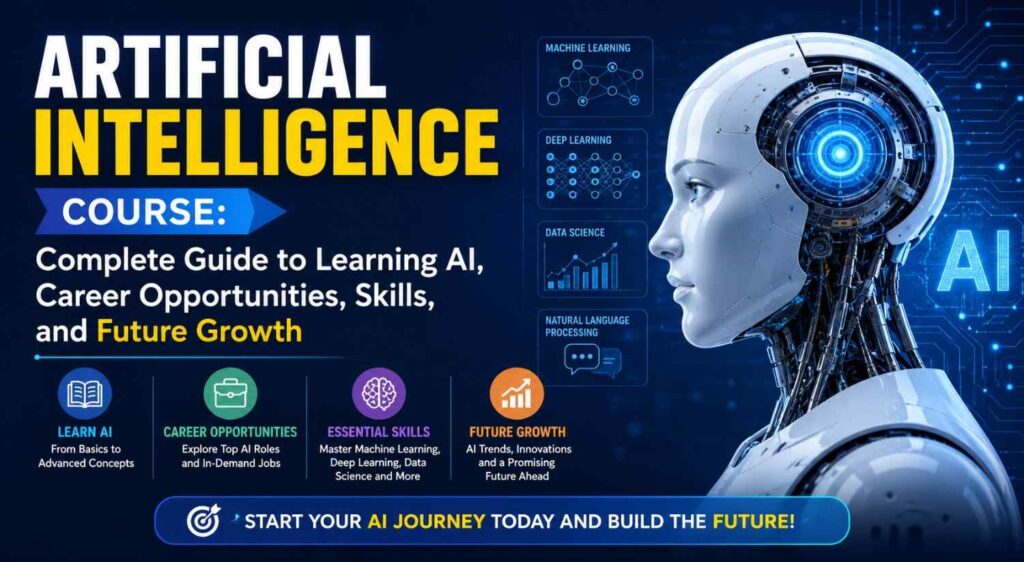
Artificial Intelligence (AI) went from a science fiction-fantasy to the most influential technology of our age and having an impact on nearly every industry in existance. AI is changing the way businesses work and how people interact with technology — in sectors ranging from healthcare, finance, education to transportation and entertainment. With the worldwide demand for AI professionals on the rise, undertaking an Artificial Intelligence course has become one of the best investments students, working professionals and entrepreneurs are making today.
What Is an Artificial Intelligence Course?
An Artificial Intelligence course is a formalised educational curriculum that teaches learners the concept, tools, technology and practical use of AI. The courses you will get in these domains are Machine Learning, Deep Learning, Neural Networks, Natural Language Processing the computer vision Robotics and data science.
An AI course is designed for teaching learners to build intelligent systems that can perform tasks that typically need human intelligence, such as decision-making, speech recognition, natural language processing (nlp), visual perception and image analysis, and predictive analytics.
AI courses are available at various levels, from beginner-friendly certifications to advanced postgraduate degrees and professional specializations.
Why Learn Artificial Intelligence?
In the age of digital economy, Artificial Intelligence has emerged as a key skill. Organizations across industries are looking out for skilled individuals who can build AI-powered solutions and are charged with driving innovation.
Learning AI has some important advantages:
- High-demand career opportunities**
- Excellent salary packages**
- Future-proof technical skills**
- Opportunities across multiple industries**
- Complex real world problem solving
- Entrepreneurship and startup opportunities**
Access to cutting-edge technologies**
As companies continue to pour huge amounts of money into automation, predictive analytics and intelligent systems, AI professionals have become the most in demand experts globally.
Topics Covered For Training In Artificial Intelligence
Commonly covered subjects in a full-structured AI course include,
1. Introduction to Artificial Intelligence
what are the key things you learn about ai
- History of AI
- AI concepts and definitions
- Types of AI
- Applications of AI
- AI ethics and responsibilities
This fundamental insight provides context for learners to grasp the wider scope of artificial intelligence.
2. Programming for AI
Programming are the foundations of AI. Most courses teach:
- Python programming
- Data structures
- Algorithms
- Object-oriented programming
- Software development fundamentals
Cloud Training for Python Courses When it comes down to simplicity and vast AI libraries available, Python is the most preferred language of choice last year as well.
3. Machine Learning
Machine Learning is your one of most predominant pillar in AI.
Topics include:
- Supervised learning
- Unsupervised learning
- Reinforcement learning
- Regression models
- Classification algorithms
- Clustering techniques
- Model evaluation
Machine learning, for its part, refers to a type of artificial intelligence in which systems are taught by data and can gain insights over time through machine function improvements without much direction.
4. Deep Learning
Deep Learning: A more sophisticated form of machine learning which employs neural networks.
5.Natural Language Processing (NLP)
Natural Language Processing (NLP) → NLP is a category of AI that helps computers be able to interpret, understand and generate human language. NLP is a fusion, combining AI, linguistics and machine learning to render machines capable of understanding and making sense of text and speech. NLP is used in multiple applications such as chatbots, virtual assistants, laundage translaters (yes, I meant language), sentiment analysis and speech recognition systems. With NLP, students can make intelligent applications that facilitate human–computer communication.
Read Also: Jelly Roll | Artificial Intelligence and Machine Learning
Skills Required for Artificial Intelligence
Having technical and analytical skills is a must for building a successful career in Artificial Intelligence. This is a Machine Learning tutorial train the learners with Programming Language like Python, Mathematics and statistics, Data Analysis and proficiency in Excel. Also, you need to have very strong analytical and logical skills by understanding machine learning concepts. Communication Skills and Learning Agility: The field of AI keeps evolving quickly, so people who can communicate effectively and are strong learners will go a long way.
Types of Artificial Intelligence Courses
Artificial Intelligence [AI] courses are available in different formats catering towards a wide range of learning needs, prior educational backgrounds and careers pathway. Certificate courses are short-term programs to understand the basics of AI, machine learning and data science which is best suited for freshers & working professionals. While degree programs offers theoretical and practical knowledge across a wide range of disciplines, diploma courses focus on delivering industry-specific skills over the short span of a few months to few years. If you want to have in-depth knowledge then we also offer a full Bachelor’s degree program which would be of 4 years long, covering artificial intelligence concepts, programming fundamentals, mathematics (probability and statistics), machine learning and other related technologies. Likewise, Masters degree programs emphasize advanced AI techniques, research and specialized applications which prepare students for leadership or expert-level positions in the industry. You also discover that online AI courses are becoming more popular, having gained significant attention in past years due to their flexibility, affordability and accessibility as learners can study at their own pace from any place of the world. They cover interactive projects, industry-recognized certifications, and hands-on training to prepare any enthusiastic individual in artificial intelligence technologies.
AI Salary and Job Market
With the widespread adoption of AI-powered technologies to improve efficiency, automate processes and make data-driven decisions, organizations around the world are generating demand. These increasing needs have resulted in the creation of several jobs for AI talent in fields like health care, finance, retail, manufacturing and technology. Hence, AI-related jobs are reputed for high salaries with a robust long-term growth prospect.
Here are the key points regarding AI salary and job market
- Increasing need for AI professionals in all sectors
- Salaries that are competitive when compared to many other types of technology career paths.
- Good Growth opportunities for freshers as well as seasoned professionals.
- High Demand for AI Engineers, Machine Learning Engineer, Data Scientist and AI Research Scientist
- Excellent job opportunities in both local and overseas markets
- AI applications continue to expand causing new job creation as every year passes.
- Work with the latest trends – machine learning, deep learning, robotics, generative AI.
As the global AI industry is thriving, people armed with Artificial Intelligence skills can enjoy fruitful careers with lucrative salary packages as well as a long-lasting career option in this emerging digital era.
How To Pick The Right Artificial Intelligence Course
When choosing the right Artificial Intelligence course, you need to consider multiple critical factors to see if the program suits your learning goals and career plans. First, check the curriculum to see if it covers topics like machine learning, deep learning, natural language processing (NLP), computer vision, data science etc. and AI ethics. The course should have theory as well as hands-on projects, case studies and implementation in a real project. Instructor credentials and industry experience are also an important factor, as being taught by seasoned professionals can greatly enrich your understanding of the principles behind AI. Also search for courses that come with well-known certifications, they may up your resume and boost job opportunities. Learning Format — It can be online or offline; self-paced or instructor-led, make sure it suits your schedule and preference. Also in return for the may seek assistance from learners are determine various elements like whether placement aid, internship, student testimonials and also pay scales along with updated AI tools. Choosing an AI course with in-depth content, hands-on training, expert support and job readiness can give learners a solid grounding in Artificial Intelligence and help them gear up for terrific careers in this field that continues to expand at light speed.
Career Prospects After Doing a Course In Artificial Intelligence
An AI Course can lead you to many rare and trending career options in multiple companies. Job Roles for Graduates: AI Engineer Machine Learning Engineer Data Scientist Natural Language Processing (NLP) Engineer Computer Vision Engineer Robotics engineer A natural language-processing(NLP) or AI research scientist These experts design smart systems, mine massive datasets, innovate automation techniques and develop deployed solutions to facilitate improved operation of businesses along with better user experience. As more organizations embrace AI across a variety of fields including healthcare, finance, education, manufacturing and retail to cybersecurity —AI professionals continue to be in high demand with attractive salaries, good job security and excellent career opportunities.
Future Scope of Artificial Intelligence
The potential of Artificial Intelligence or what we call AI in future, looks beyond bright as it keeps on revolutionizing the world and industries. From healthcare, finance, education to transportation, manufacturing and cybersecurity industries; a new wave of opportunities will open up for business as well as professionals. The rise of technologies like machine learning, robotics, automation and generative AI is expected to fuel the demand for skilled professionals in AI in the next couple of years. With a greater number of organizations deploying intelligent technologies for better decision-making and efficiency, the demand for Artificial Intelligence will be one of the most precious and growth-oriented careers in world job marketplace.
Advantages of joining in a course Artificial Intelligence
Top 5 Benefits Why Students are Taking up an Artificial Intelligence Course to Build Great Career in Technology. It anchors you in the most recent technologies like machine getting, deep understanding, data science and automation which are rapidly gaining traction over multiple industries. What Does an AI Course Do?AI courses teach real-world skills, develop problem-solving skills, and give practical experience through hands-on projects. This also improves career prospects since it provides individuals with the necessary training for high-paid jobs including, AI Engineer, Machine Learning Engineer, Data Scientist and AI Researcher. Moreover, AI education prepares professionals to be competitive in a changing job landscape, offers avenues for global employment as well as develops the expertise required to help power creative solutions that define tomorrow.
Conclusion
An Artificial Intelligence course equips you with the knowledge, skills and hands-on experience to succeed in one of the fastest growing and most interesting fields in the world today. From students considering future careers to professionals seeking to sharpen their skills, or even entrepreneurs looking for creative solutions, AI education can provide fantastic avenues for growth and success!
As industries rapidly adopt automation, machine learning, and intelligent technologies like never before, profiting from the AI journey today offers some of the most rewarding careers and pay rates – all while ensuring that professional progression stays a key component of your abilities for years to come. Choosing an Artificial Intelligence classes means more than simply learning the technology — it means building your future in innovation, business and digital transformation.
Frequently Asked Questions (FAQs)
Q1)What is an AI course?
The Artificial Intelligence course is one that imparts knowledge to the students regarding how they can build intelligent systems based on machine learning, deep learning, data science and similar disciplines.
Q2)In which portrayed, an can have mutually up?
Eligibility : Most of the courses has specific eligibility criteria, students in different stages like students, graduates and working professionals i.e software developers, business professionals.
Q3)Now back on to the matter at hand; does one need to know how to code in order to be successful in AI?
Yes, programming skills are essential for learning and implementation of AI solutions, preferably using the Python Language.
Q4)Duration to Learn Artificial Intelligence?
Some courses are only a few weeks long including many of the certification courses, while degree programs can take years to complete.
Q5)What are the jobs that I can get after an AI course?
Roles that you must be familiar with: AI Engineer, Machine Learning Engineer, Data Scientist, NLP Engineer Robotics engineer and AI Engineering Researcher.
Q6)Is Artificial Intelligence a good career option?
Yes. AI is one of the fastest-growing fields around and a growing sector with great job opportunities, good salaries, and lots of room for growth.