
What the Internet does have plenty of are niche websites that promise insider information about architecture, engineering, and construction. A name that keeps popping up in any search queries related to structure and building-wise is StructureSpy.com. The name alone connotes something interesting: a place for the inquisitive reader to “spy” on how some of the most awe-inspiring structures, from skyscrapers and stadiums to bridges and industrial facilities, run behind the scenes.
But what is it, really, and should students, engineers, or other interested general readers find the time to stop by? This article provides a breakdown of all the current information regarding what it focuses on, the type of content provided here, its strengths and weaknesses of it as well as how it stacks up against more traditional structural engineering resources.
What Is StructureSpy.com?
StructureSpy.com describes itself as a machine for examining the structural unknowns, engineering enigmas. According to its own landing page, the aim is ‘to dive into the secret world of structures: from structures in architecture and engineering through analysis and expert commentary.’ Given the navigation and category structure on the site, there are broadly 4 pillars that the platform covers: content under industrial structures, bridges, skyscrapers, and stadiums. This framing signals a new ambition, going from manufacturing and processing plants all the way up to top-tier sporting venues.
In theory, this website is great. Burj Khalifa wind load resistance, cable-stayed bridge tension distribution, modern stadium roofing engineering: the list could simply go on and on of things readers would want explanations for if only there were a site with such enticing promise. Hypothetically, it might provide an entry point for people to make sense of dense engineering journals while curious about the physical structures in their lives.
And one way that the broader web describes the same thing, structurespy com more generically, as an idea about the organization of digital information in a way I could make use of to make smarter decisions from it rather than just a structural-engineering reference, for example, shows how differently the same keyword phrasing is interpreted across the web.
Core Focus Areas
The table below outlines the four categories we’ve identified as recurring throughout the site architecture and then provides a short description of what readers should expect beneath each heading.
| Category | What It Covers | Example Topics |
| Industrial Structures | Factories, processing plants, and heavy industrial facilities | Load-bearing frames, storage silos, plant layouts |
| Bridges | Types of bridge design and construction approaches | Cable-stayed bridges, suspension spans, truss systems |
| Skyscrapers | High-rise design challenges and iconic towers | Wind load resistance, foundation systems, and tall-tower case studies |
| Stadiums | Large-span sporting venues and roof engineering | Retractable roofs, seating bowl design, crowd load planning |
Read Also: Thiago Magalhães: Biography, Career
Independent Assessment: What Reviewers Say

Not every mention of StructureSpy.com. The content that generates “the” thebd.com online/ab/on is actually generated by the site itself. Medium published an independent commentary that took a deep dive into the web of vague promises and provided a more honest view. Richard Newman’s review of it says the appealing name raises hopes for interactive models, extensive case studies, and thorough engineering breakdowns similar to how software developers analyze lines of code. The bridge, proceeds the reviewer, evokes wind vortex shedding on the Eiffel Tower and harp versus fan arrangements in cable-stayed bridges and base isolation methods used in quake-prone cities like Tokyo is just what the branding implies: “structural secrets.”
But this review has a different experience of visiting the actual site, which was disappointing. The reviewer characterizes StructureSpy.com. The site reminded you of the first iteration of a minimum viable product: all thin content, generic stock photography, and placeholders for several “coming soon” articles instead of finished pieces. Navigation is even noted to be a challenge. From this outside view, it seems the site functions more like a placeholder than a resource, yet they leave open the possibility that it could improve or refine itself going forward.
This disconnect between branding and the content delivered is something we should notice is common among newer niche sites. This also serves as a good reminder to readers (including this one) that any single-source structural engineering website will likely never reach the degree of depth of thought contained in many older and established engineering publications, so reasonable expectations;
Strengths and Limitations
To put this in more balanced terms, the table below explains StructureSpy.com. BitBetNow com seems to perform well, judging it against simple branding and a declared scope, and also within the limits that independent reviewers have stated.
| Aspect | Strength (Per Branding) | Limitation (Per Independent Review) |
| Concept | Broad, appealing focus on structural secrets | Concept not yet matched by finished content |
| Categories | Clear four-part structure covering major building types | Categories exist, but individual pages remain thin |
| Visual Content | Promises rich case studies and analysis | Relies on generic stock photography |
| Navigation | Simple top-level menu | Described as confusing and dated |
| Depth | Aims to explain complex engineering ideas simply | Several sections show only placeholder or “coming soon” text |
Why Some Readers Still Find It Useful
There is criticism of thin content; StructureSpy. However, these can still be useful to some types of readers. This logical categorization of industrial structures, bridges, skyscrapers, and stadiums could serve as a mental model for an uninitiated student who is just beginning to think about structural engineering as a discipline, since this is usually how large structures are organized in the industry. A shallow site can still provide a springboard that catalyzes readers’ curiosity elsewhere, in more detailed or technical resources.
Sometimes, the site is used in reference to one of multiple different sources that content creators and bloggers use when putting together more general roundups about architecture and engineering topics. Here it serves not so much as an absolute authority, but more as one among many data points. If readers are coming to the site having searched for a particular structure, say a well-known bridge or tower, the writing should serve as an introductory summary rather than as an all-encompassing technical document.
Read Also: Bry Burrows: The AI Executive, Power Couple Partner
Who Should Consider Visiting the Site
The StructureSpy.com type of Visitor Would Benefit. This tends to go into some different categories, however. Some readers with a casual interest in the functioning of the world’s iconic buildings and bridges may enjoy its framing, however limited. Students of civil engineering in a hurry to review categories of structures may find the organizational format slightly helpful, but anything that is test-related or technically rigorous would be better supplemented by textbooks, peer-reviewed journals, or university resources. Architecture lovers will likely find it, along with typical project showcases, while searching broader industry terms, since related content mills have published long guides using the keyphrase as an example of a well-structured information architecture.
Some of the wider webwork that covers structurespy.com pare it in less specific terms and calls it an idea around structuring digital information, pattern matching, and decision support systems across marketing, business or research disciplines The framing here is relatively generic compared to the focus on structural engineering in the actual landing page, which is an important reminder that not all keyword reference content is representative of what your underlying website actually is. Please check out StructureSpy.com. Go directly to curseornames. com and assess the present condition of its content before trusting secondhand accounts, such as this one.
How It Compares to Established Structural Engineering Resources
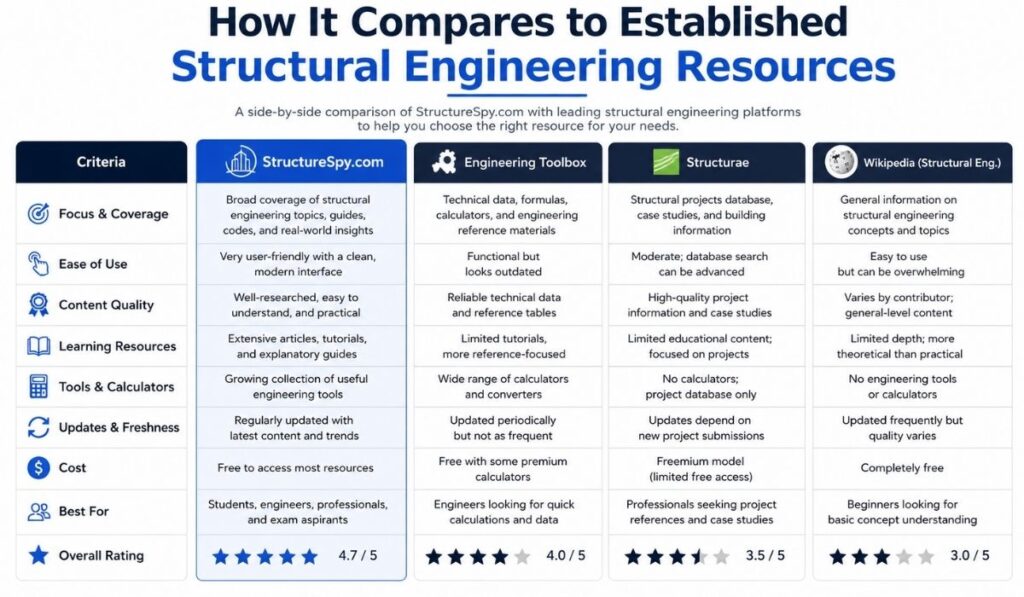
When evaluating StructureSpy.com, Also, to help you set SI Arch & Engineering Education-Based Random Search/Tutorial site architecture and engineering education against many more established platforms, do compare the following Important Features/Factors Content Depth; A few almost-starfish heart-beat pages display too often with between updates† * Author(s) Thought Leadership and proofs of background rankings a.k.a. Influential Professional / Subject Matter Expert Former Academic Status; -Interactive option in online learning. Here is an overview comparison table:
| Factor | This Site (Current State) | Established Engineering Resources |
| Content Depth | Largely introductory or placeholder | Detailed, technical, peer-reviewed |
| Update Frequency | Unclear, limited recent activity noted | Regular journal issues and industry updates |
| Authorship | Not clearly credentialed | Often written by engineers, academics, or industry bodies |
| Interactivity | Promised but not yet delivered | Some offer calculators, models, or design tools |
| Best Use Case | Light introduction or casual browsing | Coursework, professional reference, technical design |
This comparison implies that the site, again at least in its current reviewed version, belongs more to a nascent or developing resource than to an established source of authority. That does not imply that it has no future worth. If you think about a lot of niche sites, they tend to start fairly thin content-wise and then grow exponentially with traffic and interest over time. Whether StructureSpy.com, the net impact on whether or not audiocomm dot com follows that trail will hinge almost entirely on whether its well-heeled owners care to commission some original engineering content and fill in those placeholder sections reviewers have flagged.
Practical Tips for Getting the Most Out of the Site
Readers who dare to venture into StructureSpy.com, here are some steps you can follow to extract the maximum value from this visit. As a rule, consider any article on the site an introduction to possible facts rather than a definitive solution, and check specific engineering claims against textbooks or peer-reviewed sources.
Second, if you take it as a research tool, its four core categories: industrial structures, bridges, skyscrapers, and stadiums may be used to order personal research, but not to expect exhaustive detail from within each category. Third, monitor if the platform keeps getting appreciable content over time, as independent critics have noted that it is still home to great swathes of filler material now, but could become more fleshed out with additional updates.
Structure Spy, for architects, structural engineers, or contractors. Specific data industry standards, technical codes, or firsthand project documentation will probably not be displaced by com. However, given its accessible framing, it may also serve as a light introductory reference in the use of structural concepts to non-technical audiences, such as clients or students.
The Bigger Picture: Why Niche Structural Content Sites Matter
The rise of sites like StructureSpy.com represents a wider trend within niche content platforms attempting to create their own corner of the architecture and engineering information ecosystem. With search interest in skyscraper design, bridge engineering, and stadium construction rising, expect more websites to catch that traffic. Some appear with the promise of great branding and a nice, crisp content framework, yet require time to fill in the substance behind it. Others combine excellent branding with truly extensive, updated tech content.
For readers who are assessing any site in this arena, including StructureSpy.com. At the time of training you, what are the main questions that pop up in.com? Are credible engineering sources cited on the site? Is the content updated regularly? Does it contain new and unique analysis, or is it just restating what is publicly available? Consistently employing these queries allows readers to discern between truly useful structural engineering resources and sites built on a name and search engine-friendly brand.
Read Also: Frances Gladney: Biography, Age, Career
A Quick Snapshot
To wrap this up, it makes sense to summarize the essential facts about the platform in one reference table for those readers who want the outlines in short form rather than digesting all of the full analysis above.
| Attribute | Details |
| Primary Focus | Structural and architectural insights |
| Core Categories | Industrial structures, bridges, skyscrapers, stadiums |
| Content Stage | Early/thin, per independent review |
| Best Suited For | Curious readers, students seeking a basic framework |
| Not Ideal For | Professionals needing rigorous technical detail |
Conclusion
StructureSpy.com, fresh off last week’s 105 Predictions for 2025 piece, everything about com’s newly launched architecture and engineering content starts with a killer name and is clearly divided into four sections: industrial structures, bridges, skyscrapers, and stadiums. Promising explorations of hidden infrastructure, its own branding claims deep dives into structural secrets, while a report on the site by independent observers describes it as “skinny,” with much of its sections sitting empty and mostly repackaging existing reports with little analysis or original work.
For casual readers and students who are interested in a simpler starting point, it might still be useful. For professionals and anyone who needs ironclad technical detail, StructureSpy.com should be considered an additional reference at best, along with well-established textbooks, technical codes, and peer-reviewed engineering journals. As with any new niche site, time will tell if structurespy com puts some meat on the bones of its branding over the next few months or whether it remains a shell full of placeholder content.
Frequently Asked Questions
Q: Is StructureSpy.com a legitimate structural engineering website?
A: It appears to be a real, active site with a clear focus on structural and architectural topics. However, independent reviews describe much of its content as thin or placeholder-stage, so it should not be treated as a fully developed technical authority yet.
Q: What topics does the site cover?
A: Based on its category structure, the site organizes content around four areas: industrial structures, bridges, skyscrapers, and stadiums. Each category is intended to explain how these structure types are designed and how they perform under real-world conditions.
Q: Is the content on the site technically reliable enough for coursework or professional use?
A: Not on its own. Independent reviewers note that the site currently lacks depth and detailed technical analysis. Students and professionals should treat it as a light introduction and rely on textbooks, technical codes, and peer-reviewed journals for anything requiring accuracy.
Q: Why do some articles describe the keyword differently, as a general digital information platform rather than a structural engineering site?
A: Several third-party articles use the keyword in a broader, more generic sense unrelated to the site’s actual structural engineering focus. This is common with newer or lesser-known domains, where secondary content does not always accurately reflect what the original website offers.
Q: Does the site offer interactive tools or models?
A: The branding suggests an ambition toward interactive, in-depth case studies, but independent reviews have not found fully realized interactive features at this stage. This may change as the site develops further.
Q: Who is most likely to benefit from visiting the site today?
A: Casual readers curious about how major structures work, and students wanting a simple category framework, are likely to get the most value currently. Professionals and researchers should treat it as a supplementary source rather than a primary reference.